Your Feet Carry More Than Your Weight — But Your Insoles Don't
If you've tried cushioned insoles that felt great for a week then quietly gave out on you — this short article explains exactly why that keeps happening, and why the fix isn't more cushion.
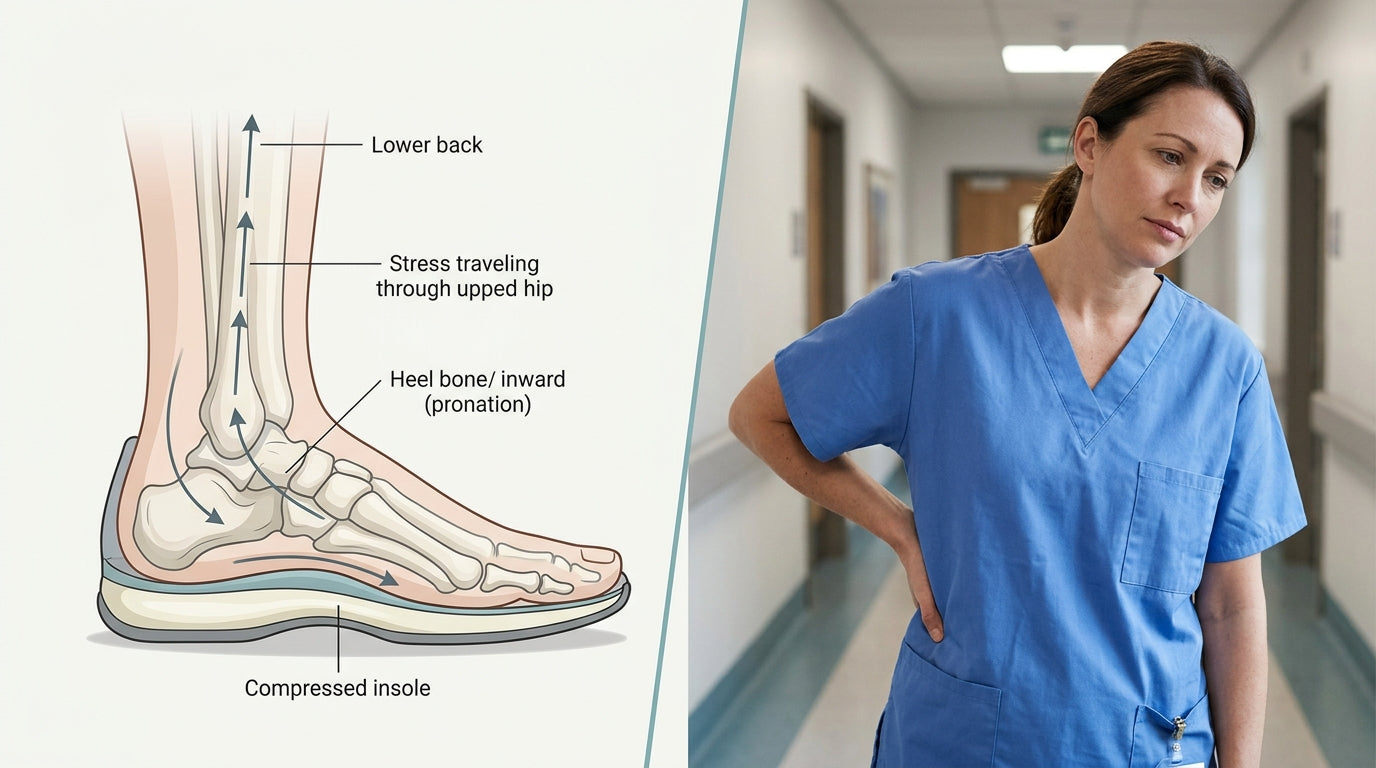
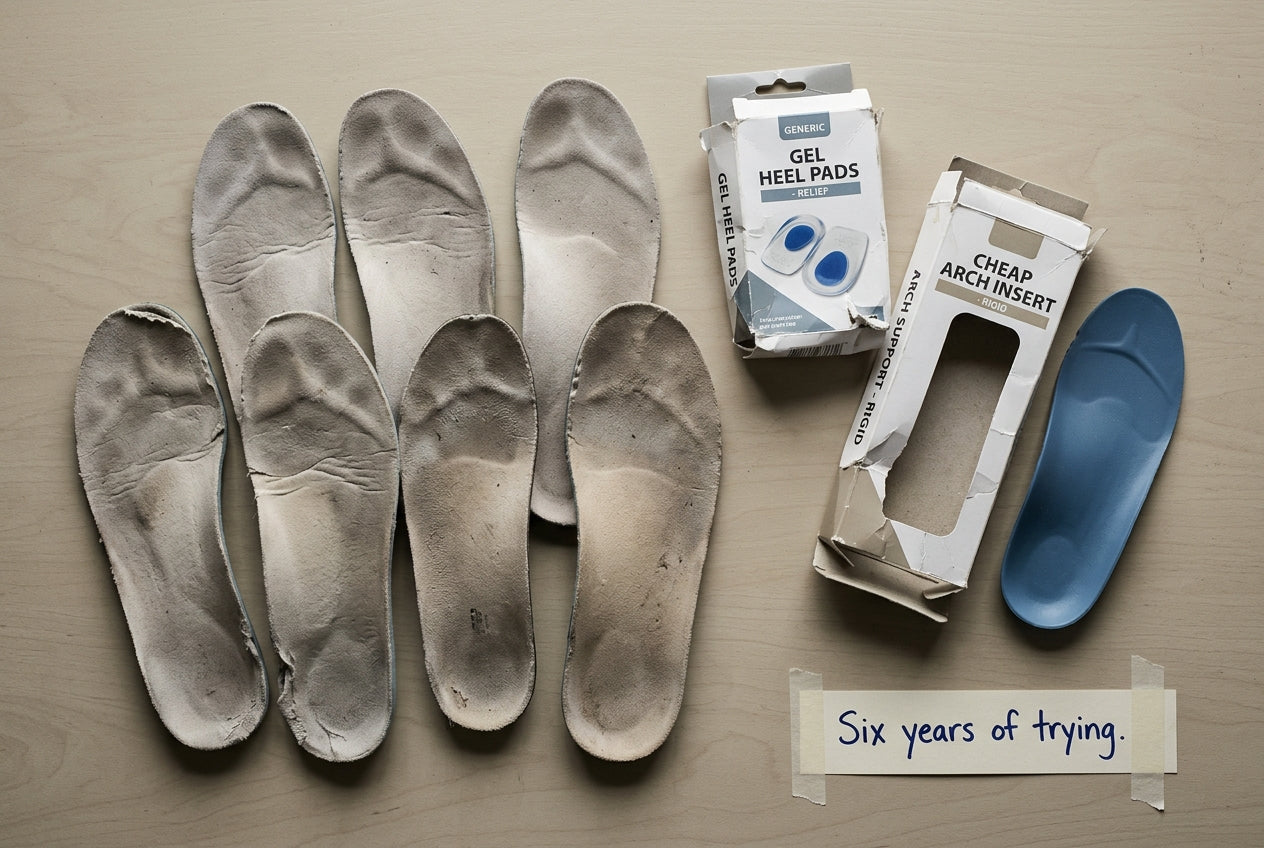
For six years, I bought insoles the way other people buy paper towels. A new pair every few weeks. Soft ones, gel ones, the $30 ones with the arch built in, the fancy in-store kiosk pair I felt foolish buying after it went flat by Thursday. Same result every time: an hour or two of relief, then my feet were on fire again by mid-afternoon — and my lower back would remind me all night that I hadn't fixed anything.
I'm a nurse. My shift starts at 6 a.m. I'm on concrete floors for twelve hours. By hour six, it felt like I was walking on two bags of sand. Burning, aching, heavy — the kind of tired that doesn't wash off when you get home.
Strong For Decades — Then Something Changed
The external cost was obvious: I kept spending. Fifteen dollars here, thirty there, eighty on a pair that a podiatry blog swore was different. Hundreds of dollars over the years, and my feet still screamed at me every shift.
The financial cost was subtler. I took a desk day twice because my feet were genuinely too bad to stand on. A desk day, for a nurse. That's not something you do twice without wondering if you're heading somewhere you don't want to go.
The part that stayed with me, though? My daughter was eight. After a long shift I had nothing left. I'd come home, sit down, and that was it. She'd ask me to play and I'd say not tonight, baby, Mama's feet. That sentence, on repeat, for years, will find you eventually.
My name is Sandra K. I'm 41, been in nursing for fifteen years — pediatrics, so I'm not just standing, I'm moving fast. I come from a family that works hard and doesn't complain much. I am not a person who quits a shift. I am not a person who sits down on the job. So when my feet started dictating my life, I did what any stubborn person does: I tried everything I could find.
I tried the Dr. Scholl's gel cushion pads — four different versions. The heel cups. The full-length foam pair from a drugstore kiosk that's supposed to analyze your arch. I tried a premium brand my coworker swore by, the green one with the rigid shell — it felt like someone had bolted a golf ball inside my shoe, and I lasted nine days before I gave up. I tried compression socks. I tried new shoes ($140, still hurts). I tried rolling a frozen water bottle under my arch every night. I tried stretching every morning for three months. I tried a cortisone shot. It helped for about five weeks, then the pain came back — more or less exactly where it left off.
None of it held. They'd help for a bit, and then the same pain, the same way, would walk right back in. Every single time.
I kept thinking: I must be doing something wrong. Or maybe this is just what forty-one feels like.
The Most Overlooked Cause of Foot Pain in People Who Stand All Day
I didn't figure out what was actually going on until a podiatrist friend walked me through something I'd never heard explained this way.
She drew it out on a napkin, which I still have somewhere.
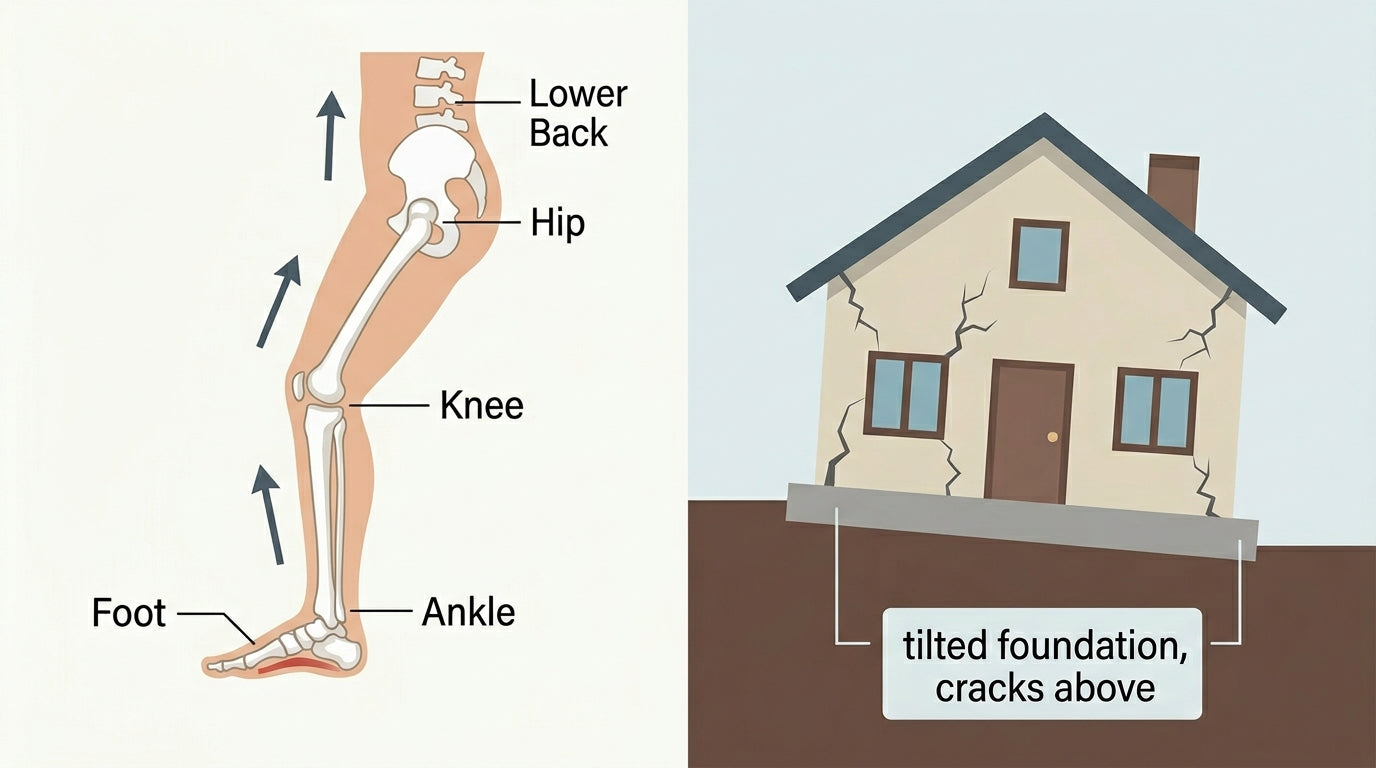
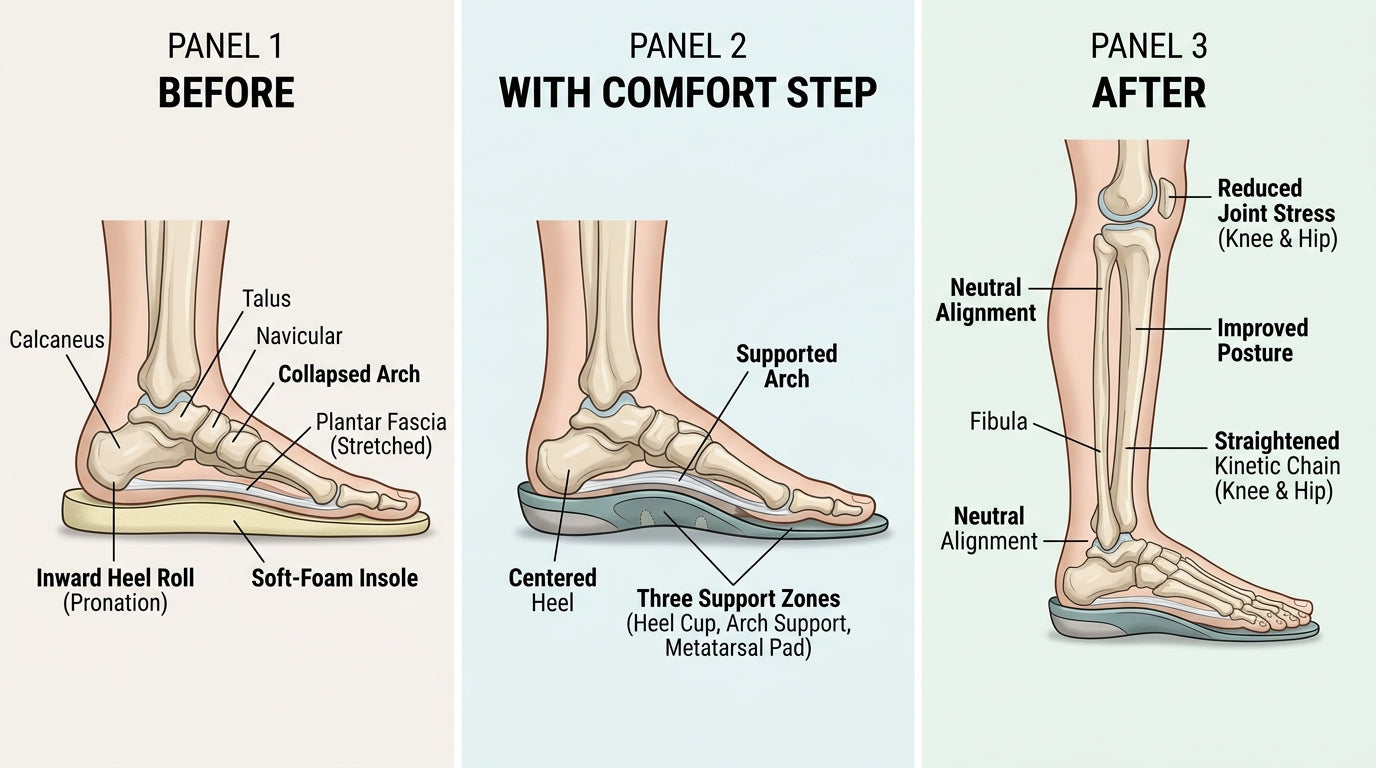
She said: when a soft insole compresses — and all foam eventually compresses, that's what foam does — your arch doesn't stay where it started. It falls. Your heel rolls inward. And the moment that happens, everything above it has to compensate. Your ankle rotates. Your knee tracks inward. Your hip tilts. Your lower back torques to catch the difference. The pain you feel in your back and your feet doesn't start in your back, and it doesn't start in your feet in the way you think. It starts in one simple structural failure: your foundation is no longer level.
She called it the tilted-foundation problem. When the base shifts, every wall above it strains.
"The support you're buying isn't actually supporting you," she said. "The moment the foam compresses, the structure is gone. You're just standing on cushion. And cushion doesn't hold an arch."
The penny dropped. Every insole I'd ever tried was built around foam. Soft, compressible foam. And the one job foam cannot do — by its literal material nature — is hold a structure under load, over time, without flattening.
I wasn't doing anything wrong. The insoles were failing at their own physics.
She mentioned a product she'd been recommending to patients: an insole built around a structural engineering principle, not a cushioning principle. A proper-noun system called the TriAxis™ 3-Zone Alignment System. Not a cushion. A structured re-stacking of the foot's three load-bearing zones.
How TriAxis™ Targets the Root, Not the Symptom
The TriAxis™ 3-Zone Alignment System is designed around one idea: your foot has three distinct contact points with the ground, and all three have to be properly positioned at the same time for the arch to stay where it belongs under load.
Here's what each zone does:
- Zone 1 — HeelLock™: Re-centers the heel bone to neutral before the arch can fall. The inward roll starts at the heel — HeelLock™ stops it at the source. The rest of the chain doesn't compensate if the base doesn't tilt.
- Zone 2 — ArchBridge™: A firm, structured arch prop that holds the fallen arch in its natural position — not by pushing a rigid ball into it (the break-in torture problem), but by bridging the full span of the arch with a graduated curve. The arch springs again the way a healthy foot is supposed to: load goes in, the arch absorbs it, the energy returns.
- Zone 3 — FlexForce™: Distributes forefoot load across the ball of the foot instead of letting it concentrate at two or three hot-spots. This is where metatarsal pain and burning ball-of-foot discomfort lives — FlexForce™ spreads the pressure so no single point takes the full force of a twelve-hour shift.
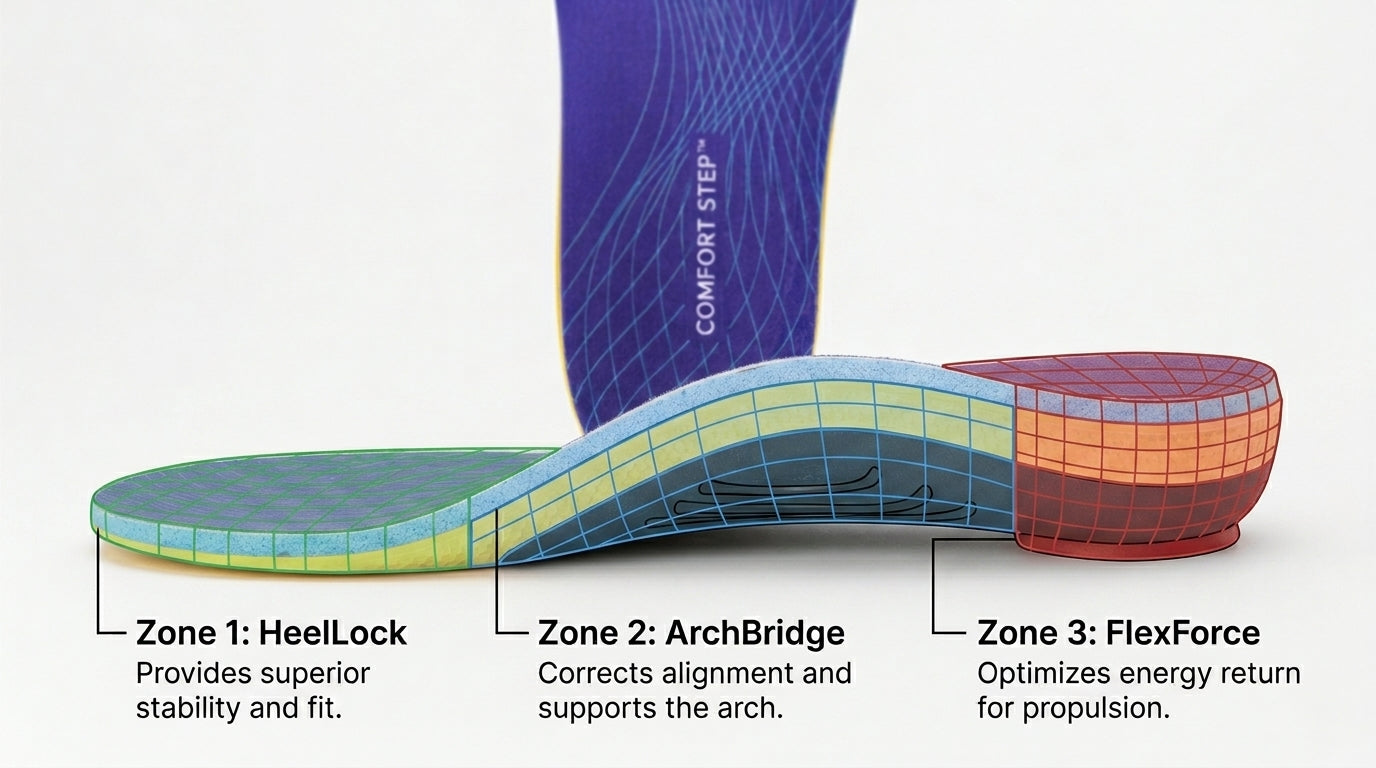
Underneath all three zones: a structural EVA/PU base that doesn't compress the way soft foam does. Lab-tested to hold its arch shape under 330 lbs of force, staying within 0.3mm of its original profile for 12 months or more. On top of the structure: DualCushion™ — a memory foam and gel comfort layer — so the first step in the morning isn't a battle.
The structure holds. The cushion comforts. Those are two different jobs, done by two different materials.
What Dr. Marchand Says About the Foundation Problem
Comfort Step was designed by Dr. Elliott Marchand, DPM — a podiatric physician with over two decades of clinical practice — with direct input from more than 1,200 practicing U.S. podiatrists.
Dr. Marchand's view on the soft-foam category is direct: cushioning addresses what a person feels without addressing what their foot is doing. When the arch falls and the heel rolls in, it doesn't matter how soft the material under your foot is — the misalignment continues. The pain returns. Because the structural problem was never corrected.
TriAxis™ was engineered to replicate the foundational realignment principle of a custom orthotic — the same intervention podiatrists prescribe at $400 or more per pair — in a drop-in insole that doesn't require a clinic visit, a cast, a three-week wait, or a painful break-in period.

I want to be honest about something.
When my friend first told me about TriAxis™ and Comfort Step, I said no. I said I'd already spent too much money on insoles that promised things they didn't deliver, and I was done. She didn't push. She just said: "Try one shift. If it doesn't feel different than what you've been wearing, throw them out."
I was skeptical for about four hours into that first shift.
By hour six, my lower back wasn't talking to me. By the time I walked out of the hospital, my feet were tired — I'm a nurse on concrete, tired is expected — but they weren't screaming. That specific burning, grinding pain that used to start at hour five? Gone. Or at least, so much quieter I kept checking in with myself to confirm.
I wore them again the next shift. And the next. Then I gave a pair to my friend Lisa, who's a retail manager and has complained about her feet for as long as I've known her. She texted me on day four: "Where have these been my whole life."
100,000+ Customers. 89% Reported Less Pain.

People who work on their feet all day — nurses, retail managers, warehouse workers, teachers, hairstylists — have been living in these things for shifts that run from eight to fourteen hours. Here's what some of them say:
"I was ready to go on partial disability from my feet. Three weeks in and I'm back to full shifts without dreading the second half of the day."
"Tried every insole on the market. These are the only ones that are still doing anything six months later."
"The first insoles I've ever bought that I didn't have to replace before they wore out my motivation."
"I've had plantar fasciitis for four years. These are the first insoles that helped me get through a shift without stopping to sit down."
Over 100,000 people trust Comfort Step. In a survey of wearers, 89% reported experiencing less pain.
From "Not Tonight, Baby" to Back in the Game

| Life Area | Before TriAxis™ | Day 30 With TriAxis™ |
|---|---|---|
| After your shift | Feet on fire, collapsing on the couch, done | Tired in the normal way — able to make dinner, help with homework |
| Mid-shift | Counting down to the end, dreading the back half | Moving through the second half without watching the clock |
| At home with family | "Not tonight — Mama's feet" | Crouching down for a hug at the door |
| Rebuying cycle | New insoles every 3–4 weeks, same result | Same pair, still holding at month six |
| Your body at work | Lower back reminding you all night | The quiet that used to live there, back |
This isn't about your feet feeling softer. It's about the structural problem your feet have been creating — for your back, your knees, your energy, and your evenings — finally being addressed at the source.
Limited-Time Offer — Save on Your First Order
Custom orthotics — the clinical gold standard that does the same foundational realignment — run an average of $400 per pair. That's before the appointment, the waiting period, and the re-fit visit.
Comfort Step delivers the same structural realignment principle — designed by a DPM with 1,200+ podiatrists behind the construction — at a fraction of the cost, with no appointment, no three-week wait, and no break-in period. Relief in days, not weeks of torture.
The offer:
- 1 pair: $49.95
- 2 pairs: $89.95 (~$44.98/pair) — Most Popular — one for your work shoes, one for your sneakers, so you're never swapping and your support is always there
Free shipping on the 2-pair bundle. A discount of $10 is applied to today's orders — the price goes to regular after this offer period.
The math on a 12-month insole vs. a $15 drugstore pair you rebuy every 3–4 weeks isn't complicated: $15 every month costs more than $44.98 once, and provides no structural support while it does it.
Try Comfort Step Risk-Free for 30 Days
Try Comfort Step for 30 days. Wear them through full shifts. Put them through the concrete, the twelve-hour rotations, the second half of days that used to wreck you.
If for any reason they're not the support you needed — return for a full refund with free return shipping and no restocking fee. No forms, no runaround, no losing money on a gamble.
Thirty days is enough time to feel the difference. Or not feel it, and send them back at no cost.
Step Into a Foundation That Holds
People on their feet all day are either solving the structural problem their foot creates — or they're managing the downstream consequences of it. Cushion manages. TriAxis™ re-stacks.
If the insoles you've tried before felt good for a week and then quietly failed you: that wasn't your fault. That was foam doing what foam does. The structure was never there to hold.
There are three choices from here:
- Keep buying soft insoles that compress by week three and wonder why the pain keeps coming back — same cycle, different packaging.
- Book a podiatrist and spend $400 on a custom orthotic — which works, if you can absorb the cost and the wait.
- Try the structural realignment principle behind the custom orthotic, designed by a DPM, in a drop-in insole with a 30-day money-back guarantee — today, at today's price.
Individual results may vary. This content is for informational purposes only and is not intended to diagnose, treat, cure, or prevent any disease or medical condition. Consult your physician before beginning any new health regimen.